
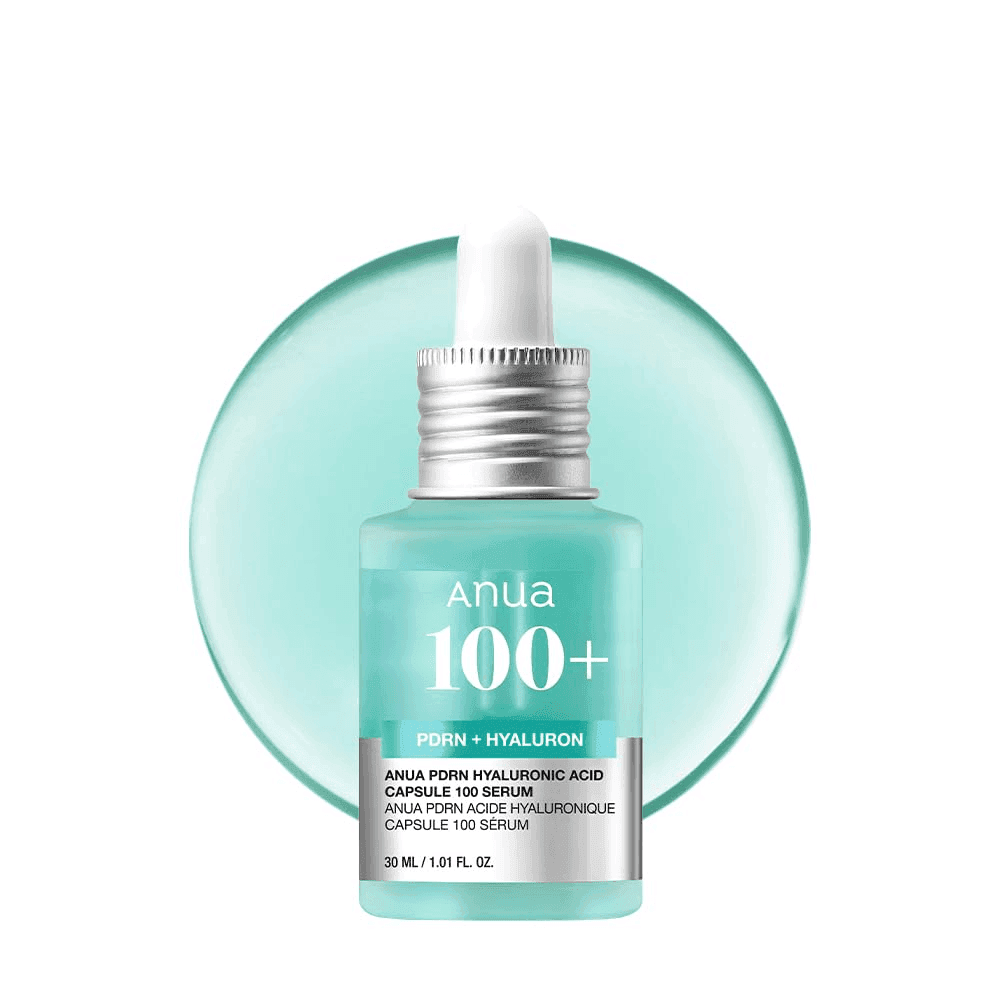
The Anua PDRN Hyaluronic Acid Capsule 100 Serum is a good hydrating serum wearing a regenerative costume. Its salmon DNA (listed as Sodium DNA) sits 21st on a 34-ingredient list — below adenosine, below glutathione, below niacinamide. Anua discloses no PDRN percentage. What you are buying is a well-built humectant serum with a competent niacinamide dose. Judge it on that, and it’s worth the money.
This review is specifically about the PDRN Hyaluronic Acid Capsule 100 Serum (the emerald-tinted dropper bottle, 1.01 fl oz). Anua sells at least four things with “PDRN” on the label, and they are not the same formula. Reviews that blur them are useless to you at the point of purchase.
What’s actually in the Anua PDRN serum?
The ingredient order as published, condensed to the first eighteen:
Water, Butylene Glycol, Propanediol, Glycerin, Hydrolyzed Hyaluronic Acid, 1,2-Hexanediol, Niacinamide, Glyceryl Oleate, Lauryl Glucoside, Myristyl Glucoside, Polyglyceryl-6 Laurate, Hydrogenated Lecithin, Glutathione, Hydrolyzed Collagen, Sodium Hyaluronate, Coptis Japonica Root Extract, Adenosine, Melia Azadirachta Leaf Extract, Melia Azadirachta Flower Extract, Coccinia Indica Fruit Extract, Sodium DNA.
Positions two through six are glycols, glycerin and hyaluronic acid — humectants. This is a hydration serum by construction. Nothing wrong with that; it is simply not what the front of the box is selling.
The genuinely useful active is niacinamide at position seven. Third-party estimates put it in the 1.3–2% range, though that is an estimate, not a disclosure. Bissett and colleagues found topical niacinamide reduced yellowing, wrinkling, red blotchiness and hyperpigmented spots in aging facial skin. That is real evidence for an ingredient really present at a plausible dose — and it is not the ingredient on the label.
How much PDRN does the Anua PDRN serum actually contain?
Nobody outside Anua knows, and Anua does not say.
What we can say is where it sits. Under 21 CFR 701.3, cosmetic ingredients are declared in descending order of predominance — but the rule also permits everything at 1% or less to be listed in any order. So position is informative down to roughly the 1% line, then stops meaning anything.
Sodium DNA is 21st on Anua’s own ingredient list (Ulta agrees; INCIDecoder shows it 18th, in a slightly different order). Either way it sits below adenosine, which in Korean formulations is typically used around 0.04%. We cannot convert that into a PDRN percentage — the ordering rule forbids the inference — and we are not going to invent one. But there is no reading of that list on which PDRN is a headline-quantity ingredient. It is a below-the-line inclusion in a product named after it.
Compare Anua’s own cream, where Sodium DNA appears 7th. The company can clearly push PDRN up a formula when it wants to. In the serum — pricier, more heavily marketed, and the one people search for — it didn’t.
If you want the Anua PDRN experience with the salmon DNA meaningfully higher in the formula, the Anua PDRN Hyaluronic Acid 100 Moisturizing Cream puts Sodium DNA above hydrolyzed collagen and every botanical extract, and pairs it with squalane and niacinamide for barrier support — which is a more coherent product than the serum it’s usually bought alongside.
And if you have read this far and still want the serum on its own terms — as a genuinely pleasant, non-sticky, eleven-hyaluronic-acid hydrator with a real niacinamide dose — the Anua PDRN Hyaluronic Acid Capsule 100 Serum is a competent buy at around $17–28. Just buy it for the hydration, not the DNA.
Does topical PDRN work at all?
This is where most reviews go wrong in one of two directions: either “salmon DNA rebuilds your skin” or “topical PDRN is a total scam.” Both are wrong.
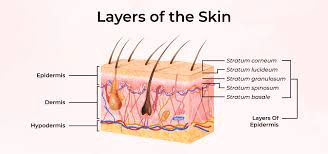
The penetration problem is real and it is arithmetic. Bos and Meinardi’s 500 Dalton rule holds that compounds need to be under roughly 500 Daltons to cross the stratum corneum, noting that all known drugs used in transdermal delivery systems fall under that threshold. PDRN is a polymer of DNA fragments orders of magnitude heavier, and it carries a strong negative charge from its phosphate backbone — which the skin’s own negatively charged surface repels. Our deep dive on PDRN absorption and topical bioavailability works through the physics.
That is why PDRN’s strongest human evidence is injected. Squadrito and colleagues’ randomised, double-blind, placebo-controlled trial in diabetic foot ulcers found 37.3% complete healing on PDRN versus 18.9% on placebo (P = .0027) — delivered by intramuscular and perilesional injection. Nobody achieved that with a dropper. Our comparison of topical PDRN versus injection covers the gap.
But here is the part the sceptics miss. In 2026, Ye and colleagues published a randomised, double-blind, split-face trial in PLoS One using a purpose-engineered medium-length PDRN (PDRN-850K) at a disclosed 0.1% in an eye cream, against 0.1% retinol, twice daily for 28 days in 31 participants. The PDRN arm produced roughly two-fold greater improvements in periocular wrinkles, dermal thickness and density than retinol, and the authors verified penetration with confocal Raman spectroscopy rather than assuming it.
So topical PDRN is not inherently inert. But look at what that study needed: a specific fragment length chosen for penetration, at a stated concentration, in a formula built to deliver it, with penetration measured. Anua discloses none of those four things. The trial that vindicates topical PDRN is also the trial that shows why you cannot extrapolate from it to an unlabelled inclusion at position 18.
One further caution: the frequently cited Kim 2022 Molecules study on topical PDRN with vitamin C and niacinamide is often waved at consumer serums. It was conducted in UV-irradiated mice and cell culture, and the mixture was delivered via microneedling — a breached barrier. It is not evidence for a serum you pat on.
What does Anua actually claim — and what did it test?
To Anua’s credit, the brand is more restrained than its resellers. Its own product page does not claim PDRN regenerates anything. It says only that “pdrn (sodium dna) is derived from salmon dna,” and describes “Smart Capsule 100 Delivery” as “microcapsule technology helps support effective hydration delivery.”
Note the noun. Hydration delivery. Not PDRN delivery.
The two numbers Anua publishes are:
- “Temporary hydration and moisture plumping effect improved by 8.93% after 1 use.”
- “Temporary deep skin hydration improved by 24.64% after 1 use.”
These are manufacturer panel claims, not peer-reviewed data, and no sample size, method or control is stated. They are also — read them again — hydration claims, measured after one use, explicitly labelled temporary. Anua is telling you exactly what this product is. The word “regenerative” is being supplied by the internet, not by the manufacturer.
The “100” refers to the capsule delivery system and the eleven hyaluronic acid types, not to a PDRN concentration.
How does it compare to the alternatives?
The single most useful axis for a PDRN topical is not price. It is whether the brand tells you how much PDRN is in the bottle.
| Product | Sodium DNA position on INCI | PDRN % disclosed? | PDRN source | Typical price |
|---|---|---|---|---|
| Anua PDRN HA Capsule 100 Serum | 21st of 34 | No | Salmon | ~$17–28 |
| Anua PDRN HA 100 Moisturizing Cream | 7th | No | Salmon | ~$18–24 |
| medicube PDRN Pink Peptide Serum (salmon version) | 8th of 40 | 10,000 ppm (1%) on medicube’s Korean product page | Salmon | ~$19 |
| VT PDRN 100 Essence | 31st of 31 (last) | Claims 100,000 ppm, which fits its ginseng extract (3rd), not the DNA | Ginseng (plant) | ~$26 |
A stated number isn’t automatically a disclosure. VT’s PDRN 100 Essence advertises 100,000 ppm (10%) of “PDRN”, but its Sodium DNA is the last of 31 ingredients. That 10% figure fits the ginseng extract VT sells as “PHYTO PDRN”, which sits third. We work through the numbers in our VT PDRN 100 Essence review. For every product we’ve checked, including which brands print a real DNA dose on the label, see our PDRN product database.
If the salmon-DNA sourcing matters to you and you want it higher in the formula than Anua’s serum puts it, medicube’s PDRN Pink Peptide Serum lists Sodium DNA 8th and adds a five-peptide complex, which is a more honest ingredient deck for the same money. medicube’s Korean product page states 10,000 ppm (1%), though its US page doesn’t, and make sure you get the salmon version: the vegan “Rose PDRN” version lists Sodium DNA 30th. Our PDRN concentration guide explains why that silence is the industry norm, and our guide to PDRN sourcing covers why source material matters as much as dose.
Who should buy it, and who should skip it
Buy it if you want a lightweight, fast-absorbing hydrating serum that layers well and doesn’t pill under makeup; you have normal, combination or dehydrated skin; you’d benefit from ~1.5% niacinamide; and you’re happy paying serum money for excellent humectants. On those terms it is genuinely good, and the 4.6-star average across 1,300+ Amazon ratings reflects a product that does what it physically does very well.
Skip it if you are buying it for the PDRN. If the reason this bottle is in your cart is salmon DNA, you are paying a premium for an ingredient at an undisclosed position-18 dose, in a format the literature says struggles to reach the dermis. That money buys more elsewhere — including from Anua’s own cream.
Definitely skip it if you have been told it’s comparable to a clinic PDRN treatment. Rejuran and its injectable relatives put the material under the barrier; a serum cannot. If you have a fish allergy, note that Galeano’s group describes PDRN purification as removing pharmacologically active proteins and peptides — protein being what drives fish allergy — but that is a purification target, not a guarantee for you personally. Ask a qualified provider who knows your history.
Frequently asked questions
Is the Anua PDRN serum worth it? As a hydrating serum with a useful niacinamide dose, yes — it’s well formulated and fairly priced at roughly $17–28. As a PDRN treatment, no. The salmon DNA is 18th on the ingredient list at an undisclosed concentration, and Anua’s own published claims are about temporary hydration, not regeneration.
How much PDRN is in the Anua serum? Anua does not disclose it, and it cannot be reliably inferred. US labelling rules let anything at 1% or less be listed in any order, so its 18th position tells you it is a minor inclusion but not the number. No independent assay of this product that we could locate has been published.
Does the “100” mean 100% PDRN? No. Anua uses “Capsule 100” to describe its microcapsule delivery system and the serum’s eleven hyaluronic acid types. It is not a PDRN concentration.
Is Anua’s PDRN serum better than its PDRN cream? For PDRN content specifically, the cream has the stronger deck — Sodium DNA appears 7th rather than 21st. For texture under makeup on oily or combination skin, the serum is the nicer product. Neither discloses a percentage.
Can a topical PDRN serum replace PDRN injections? No. The placebo-controlled human evidence for PDRN comes from injected delivery. The one good topical trial we could find used a purpose-engineered 0.1% medium-length PDRN with verified penetration — conditions no consumer serum on this list documents. See our review of what the PDRN efficacy data actually shows.
The honest verdict
The Anua PDRN Hyaluronic Acid Capsule 100 Serum is a very good hydrating serum with a marketing problem it didn’t entirely create. Anua’s own copy is careful; the hype is downstream. Underneath it is glycerin, eleven hyaluronic acids, a working niacinamide dose, glutathione, and a trace of salmon DNA doing the branding.
Topical PDRN is not a scam — the 2026 split-face trial settles that. But that trial worked because it controlled fragment length, stated its concentration, and proved penetration. Until Anua does any of those three, the PDRN in this bottle is a claim, not a dose.
Buy it because it hydrates beautifully. Not because of the fish.