
Affiliate disclosure: This review contains Amazon affiliate links. PDRN Guide may earn a commission from qualifying purchases at no additional cost to you. Our editorial take on the product is based on the ingredient list, the brand’s own published claims, and the research literature, not commission rate. See our editorial policy.
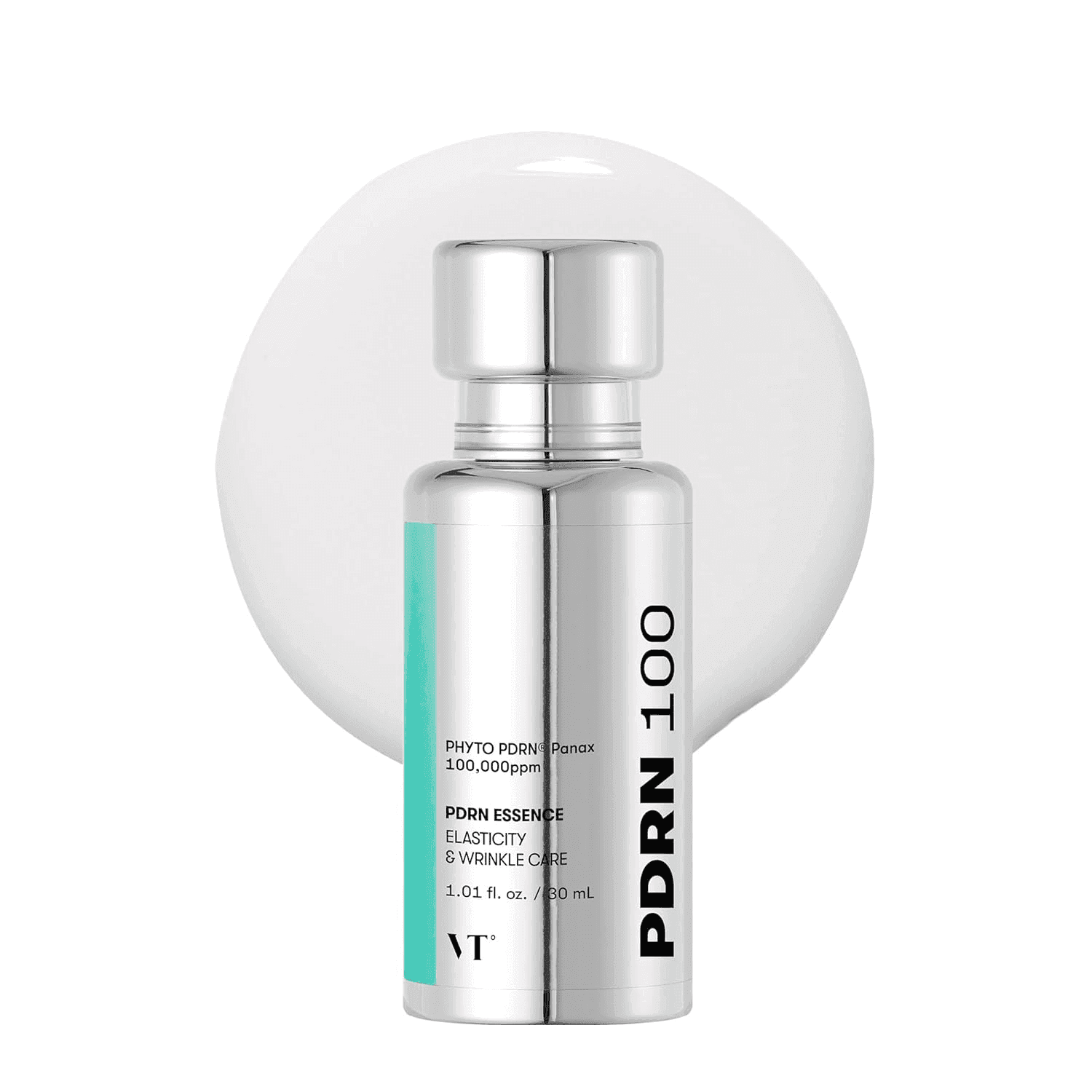
The VT Cosmetics PDRN Essence 100 is a fragrance-free, milky essence built on emollients, ginseng extract and niacinamide. The bottle says “Vegan 100,000 PPM PDRN”, which reads like a 10% dose of DNA. The label doesn’t support that reading. Sodium DNA, the ingredient that actually is DNA, is the last of 31 ingredients. Panax Ginseng Root Extract, the material VT markets as “PHYTO PDRN® PANAX”, is third. The most plausible reading is that the 100,000 ppm describes the ginseng extract. Buy this as a pleasant ginseng-and-niacinamide essence. Don’t buy it as a high-dose PDRN product.
We have not used this product on our own skin. This review is built from VT’s published ingredient list and claims, cross-checked against INCIDecoder, and from the research literature. Where we describe texture, we are quoting VT.
It covers the PDRN Essence 100 (30 ml / 1 fl oz), which Amazon lists as the “PDRN 100 Essence, Intensive Glow Serum”. If you searched for a “VT PDRN serum”, you may mean this or the PDRN Reedle Shot 100. They are different formulas, and we compare VT’s PDRN range below.
What’s actually in the VT PDRN Essence 100?
Here is the full ingredient list as VT publishes it on its own product page. INCIDecoder shows the same 31 ingredients in the same order.
Water, Isopropyl Myristate, Panax Ginseng Root Extract, Caprylic/Capric Triglyceride, Cetyl Ethylhexanoate, Glycerin, Propanediol, Niacinamide, Polyglyceryl-2 Dipolyhydroxystearate, PEG-30 Dipolyhydroxystearate, Polyglyceryl-3 Diisostearate, 1,2-Hexanediol, Tocopherol, Hydroxyacetophenone, Helianthus Annuus (Sunflower) Seed Oil, Acrylates/C10-30 Alkyl Acrylate Crosspolymer, Arginine, Adenosine, Ceramide NP, Adansonia Digitata Seed Oil, Disodium EDTA, Hydrogenated Lecithin, Allantoin, Squalane, Panthenol, Polyglucuronic Acid, Ceramide NS, Ceramide AS, Ceramide EOP, Ceramide AP, Sodium DNA.
What that list tells you:
- It’s an emulsion, not a watery essence. Three of the top five ingredients are emollient esters and oils (isopropyl myristate, caprylic/capric triglyceride, cetyl ethylhexanoate), with emulsifiers at positions 9 to 11. That matches VT’s own description of a “smooth milky texture” that leaves “a glowing moisturizing layer.”
- Ginseng extract is third. This is the ingredient VT’s marketing is built around.
- Humectants and niacinamide follow. Glycerin and propanediol, then niacinamide at 8.
- The preservative system is 1,2-hexanediol (12) and hydroxyacetophenone (14). There is no phenoxyethanol, no ethylhexylglycerin and no fragrance on the list.
- The tail is a support cast. Adenosine (18), five ceramides, squalane, panthenol and allantoin.
- Sodium DNA is 31st of 31. It comes after the preservatives and after all five ceramides.
Our PDRN product database explains how we read ingredient order and lays this list out alongside other PDRN products.
Does the VT PDRN Essence 100 really contain 100,000 ppm PDRN?
Not as DNA, going by its own label.
Start with the arithmetic. 100,000 parts per million is 100,000 ÷ 1,000,000, which is 10%.
Now the labelling rule. Under 21 CFR 701.3, US cosmetic ingredients are declared in descending order of predominance. Anything at 1% or less may be listed in any order, but only after the ingredients above 1%. So a 10% ingredient has to appear ahead of everything present at less than 10%.
Sodium DNA appears after 30 other ingredients. The list plainly follows descending order, starting with water. On that ordering, for Sodium DNA to be at 10%, all 30 would need to be at 10% or more. That adds up to more than 300% of the bottle. The arithmetic rules it out.
So where does 10% fit? Near the top of the list. The third ingredient is Panax Ginseng Root Extract, the same material VT sells as PHYTO PDRN® PANAX. VT never writes “the 100,000 ppm is the ginseng extract,” so we present this as the most plausible reading, not a proven fact. Three things point that way:
- VT’s own wording on a sister product. The PDRN Cream 100 product page describes “100,000 PM of PHYTO PDRN® Panax” (VT’s spelling). The figure is attached to the ginseng-branded ingredient by name.
- Retailer wording. Ulta describes the key ingredient of VT’s PDRN Capsule Cream 100 as “PHYTO PDRN Panax PDRN 100,000 ppm.”
- When VT does print a DNA dose, it is tiny. The PDRN Reedle Shot 100’s ingredient list, on VT’s own site, reads “Sodium DNA(0.05ppm)”. That is 0.000005%. The PDRN Cream 100’s list, as published by YesStyle and INCIDecoder, reads “Sodium DNA (0.5ppm)”, or 0.00005%.
VT doesn’t print a figure for the Sodium DNA in this essence, so we don’t know its dose, and we are not going to invent one. What the label does show is that it is the lowest-ranked ingredient in the bottle.
Is ginseng extract “PDRN”?
Not in the sense the research uses. In the clinical literature, PDRN is a purified DNA drug. Galeano and colleagues describe it as “a DNA-derived drug from Oncorhynchus mykiss (Salmon trout) or Oncorhynchus keta (Chum Salmon) sperm,” purified to “a >95% pure active principle.” A ginseng root extract is a whole-plant extract with many components. Its INCI name describes the extract, not DNA, which is why our database classifies it as not DNA.
VT says its PDRN is a “low molecular weight vegan PDRN extracted from wild ginseng,” and that it is sourced from ginseng “rather than the commonly used fish derivatives.” Plants have DNA, so ginseng-derived Sodium DNA is possible. But the INCI name “Sodium DNA” doesn’t state a source, and VT publishes no fragment size or purity for it.
This matters because “100,000 ppm PDRN” invites a comparison with the salmon-DNA PDRN used in clinics. That comparison doesn’t hold on this label.
Does topical PDRN work at all?
Even with a real dose, getting DNA through skin is hard. Bos and Meinardi’s 500 Dalton rule argues that a compound must be under roughly 500 Daltons to be absorbed through intact skin. PDRN fragments are far larger than that. Our deep dive on PDRN absorption and topical bioavailability works through the details, and our comparison of topical PDRN versus injection explains why the strongest human evidence is injected.
That doesn’t make topical PDRN worthless. In 2026, Ye and colleagues published a randomised, double-blind, split-face trial comparing a 0.1% medium-length PDRN (PDRN-850K) eye cream with 0.1% retinol over 28 days. The PDRN arm produced roughly two-fold greater improvement in periocular wrinkles, dermal thickness and density, and the team checked skin delivery with confocal Raman spectroscopy.
Look at what that result needed: a defined fragment length, a disclosed concentration, and measured penetration. VT publishes none of those three for the Sodium DNA in this essence. If you are new to the ingredient, our complete guide to what PDRN is covers the basics.
What the rest of the formula can do
Judge this essence on the ingredients that sit high enough to matter.
Ginseng extract. Ginseng is a legitimate skincare ingredient, but the human evidence is thinner than the marketing. Hwang and colleagues ran a randomised, double-blind, placebo-controlled study in 23 people using a cream with an enzyme-modified ginseng extract around the eyes. Compared with placebo, it reduced the global photo-damage score and several skin-roughness measures. That was a specific processed extract, and VT doesn’t say whether its extract is comparable. A 2023 systematic review by Cong and colleagues found ginsenoside research is mostly cell and animal work, concluding that “the direct clinical application of ginsenosides for skin diseases treatment remains limited.” It also notes that cosmetics “mainly utilize crude ginseng extracts rather than pure ginsenosides.”
Niacinamide (8th). Bissett and colleagues’ 12-week, double-blind, split-face study in 50 women found a moisturizer with 5% niacinamide improved fine lines, hyperpigmented spots, texture, red blotchiness and sallowness versus the same moisturizer without it. VT doesn’t disclose its niacinamide percentage, so we can’t say whether this essence is in that range.
Adenosine (18th). In a randomised, placebo-controlled study from L’Oréal, Abella found adenosine-containing products applied twice daily for two months improved skin smoothness around the eyes. Again, VT’s dose isn’t disclosed.
The ceramides, squalane and panthenol round out a fragrance-free formula. None of this makes the essence a treatment. It makes it a reasonable daily product.
How to use VT PDRN Essence 100
The general rules from our guide to using PDRN serum apply here. They are formulation logic and convention, not results from trials on this product.
- Cleanse, then pat your face until it’s damp, not dry.
- Apply a watery toner first if you use one. Thinnest goes on first.
- Apply the essence. Use enough to cover your face in a thin layer and press it in rather than rubbing. Because it is a milky emulsion, it goes after watery layers and before creams.
- Follow with your moisturizer. Sealing the routine with a cream helps hold what you applied against the skin.
- In the morning, finish with sunscreen. Sunscreen always goes last.
How often: once or twice a day. If you only use it once, evening is the better slot, because nothing competes with it overnight. There’s no ramp-up needed.
With the Reedle Shot: VT’s own routine suggests applying the essence after its Reedle Shot 100 or 300 at night. Our how-to guide treats spicule products like the PDRN Reedle Shot 100 as an occasional addition rather than a daily step, so use the essence alone on the other nights.
As a primer: VT also suggests using it as a primer or mixing it into foundation. That is a cosmetic use, and the emollient base makes it plausible for a dewy finish.
When to judge it: anything you notice in the first week is hydration. Give any routine change 8 to 12 weeks before you decide.
How it compares with VT’s other PDRN products
VT uses “100” and “PDRN” across a whole range, and the formulas differ. Here is what the labels show.
| Product | Sodium DNA position | DNA dose printed? | “100,000 ppm” claim? |
|---|---|---|---|
| PDRN Essence 100 | 31 of 31 (last) | No | Yes, “Vegan 100,000 PPM PDRN” |
| PDRN Capsule Cream 100 | 45 of 67 | Not on VT’s page; INCIDecoder shows 0.5 ppm | Yes |
| PDRN Reedle Shot 100 | 41 of 53 | Yes, 0.05 ppm | No |
In every case, the ginseng extract VT calls PDRN sits above the DNA, and the DNA itself sits low on the list. Our database of PDRN products lets you compare these against other brands. For a contrast outside VT, our Anua PDRN serum review looks at a salmon-DNA serum with the same kind of label question, and our round-up of the best PDRN serums ranks options on formula rather than the number on the box.
Who should buy it, and who should skip it
Buy it if you want a fragrance-free, milky first-step essence; you like ginseng-based formulas; you’d enjoy a layer with niacinamide, adenosine and ceramides under your moisturizer; or you want a dewy base under makeup. On those terms, the VT Cosmetics PDRN Essence 100 is a reasonable buy.
Skip it if the reason it’s in your cart is the “100,000 ppm PDRN.” On the label’s own evidence, that figure most plausibly describes the ginseng extract, and the DNA is the last ingredient. Also skip it if you want the salmon-derived PDRN the clinical research is built on, or a concentration you can verify.
Consider the texture if your skin dislikes rich, oil-containing products. The second ingredient is an emollient ester, isopropyl myristate, and the formula includes several oils. Patch test first if you’re unsure.
Don’t expect clinic results. Rejuran and other injectable PDRN treatments place the material under the skin barrier. An essence can’t do that.
Frequently asked questions
Is VT PDRN Essence 100 worth it? As a fragrance-free, milky essence with ginseng extract and niacinamide, it’s a reasonable daily product. As a PDRN treatment, no. Sodium DNA is the last of 31 ingredients, and VT doesn’t disclose its dose.
Does VT PDRN Essence 100 really contain 100,000 ppm of PDRN? Not as DNA, going by the label. 100,000 ppm is 10%, and a 10% ingredient would have to be listed near the top. Sodium DNA is listed last. The ginseng extract VT brands as PHYTO PDRN® PANAX is third, which is the most plausible match for the figure, though VT doesn’t state the mapping outright.
How do you use VT PDRN Essence 100? After cleansing and any watery toner, apply a thin layer to damp skin, press it in, then follow with moisturizer. Use sunscreen last in the morning. Once or twice daily works. If once, use it at night.
Is VT’s PDRN vegan? Is it from salmon? VT says its PDRN comes from Korean ginseng rather than fish, and markets it as vegan. The ingredient name “Sodium DNA” doesn’t state a source, and VT doesn’t publish its fragment size or purity.
Is the VT PDRN Essence 100 the same as the VT PDRN serum or Reedle Shot 100? No. The Reedle Shot 100 is a separate formula with spicules, and VT prints its DNA dose as 0.05 ppm. Amazon calls the essence an “Intensive Glow Serum,” which is why the names get mixed up.
Can I use VT PDRN Essence 100 with the Reedle Shot? Yes. VT’s own routine puts the essence after the Reedle Shot at night. We’d treat the Reedle Shot as an occasional step rather than a daily one.
The honest verdict
The VT Cosmetics PDRN Essence 100 is a pleasant, fragrance-free, milky essence with a legitimate botanical at the top and some useful supporting ingredients. The problem is the headline. “100,000 ppm PDRN” reads as a 10% DNA dose, and the label shows DNA as the last of 31 ingredients. The most plausible reading is that the number belongs to the ginseng extract.
VT deserves credit for printing a DNA dose on some of its other products. We’d like to see the same number on this one.
Until then, buy the VT PDRN Essence 100 for the ginseng, niacinamide and texture. Not for the DNA.