
The 7 Best PDRN Products for 2026, by Format
This is the hub for anyone deciding which PDRN (polydeoxyribonucleotide) product to actually buy, whichever format you land on. We did not test these on our own skin — we are a research and editorial team, not a clinic — so every pick is built on disclosed ingredient lists, verified product specs, PDRN format and source, and aggregated review data from thousands of Amazon buyers.
Instead of ranking near-identical bottles one to seven, we chose a single best PDRN product for each format and use case: the best serum, cream, mask, eye product, essence, premium option and budget buy. Start here if you do not yet know which format you want, then branch into the deeper category guide that fits your skin. Every pick wins one job and carries at least one drawback that might send you elsewhere.
Shop by format with our deeper comparisons: best serums, creams, masks, moisturisers, eye care, salmon-derived serums, and sensitive skin.
- Whether the product genuinely features PDRN (sodium DNA) rather than name-dropping it, judged by any dose the label discloses, or by ingredient-list position when it gives none
- PDRN source: salmon/trout DNA (the material the human research used) versus plant-derived
- How well the format fits a specific job — serum, cream, mask, eye care, essence, ampoule or daily pads
- What the surrounding formula does, because with topical PDRN the supporting actives usually drive the visible result
- Aggregated Amazon rating and review volume as a real-world reliability signal
Affiliate disclosure: We earn a commission if you buy through the Amazon links on this page, at no extra cost to you. We are a research and editorial team, not clinicians, and we did not physically test these products — see our method below and our editorial policy. Prices and availability change; check the current price on Amazon before buying.
The quick winners
- Best Overall medicube PDRN Pink Peptide Serum (Salmon DNA) Check price
- Best Cream / Moisturizer Anua PDRN Hyaluronic Acid 100 Moisturizing Cream Check price
- Best Overnight Mask BIODANCE Rejuvenating Caviar PDRN Real Deep Mask Check price
- Best Eye Care medicube Eye Serum with Salmon DNA PDRN & Pink Peptides Check price
- Best Essence VT Cosmetics PDRN 100 Essence Check price
- Best Premium REJURAN Turnover Ampoule (c-PDRN) Check price
- Best Budget medicube Salmon DNA PDRN Pink Collagen Jelly Toner Pads Check price
Compare at a glance
| Product | Price | PDRN source | Format | Skin type | Size | |
|---|---|---|---|---|---|---|
| Best Overallmedicube PDRN Pink Peptide Serum (Salmon DNA) | $ | Salmon DNA | Serum | All / normal | 1.01 fl oz (30 ml) | Check price |
| Best Cream / MoisturizerAnua PDRN Hyaluronic Acid 100 Moisturizing Cream | $$ | Salmon DNA | Cream / moisturiser | Normal / dry | 2.02 fl oz (60 ml) | Check price |
| Best Overnight MaskBIODANCE Rejuvenating Caviar PDRN Real Deep Mask | $ | Salmon DNA (last ingredient) | Overnight hydrogel mask | All, esp. dehydrated | Overnight hydrogel sheets | Check price |
| Best Eye Caremedicube Eye Serum with Salmon DNA PDRN & Pink Peptides | $ | Salmon DNA | Eye cream (sold as eye serum) | All (eye area) | 1.01 fl oz (30 ml) | Check price |
| Best EssenceVT Cosmetics PDRN 100 Essence | $$ | Ginseng extract (not DNA); trace Sodium DNA, source not stated | Essence | All, incl. fish-avoidant | 1.01 fl oz (30 ml) | Check price |
| Best PremiumREJURAN Turnover Ampoule (c-PDRN) | $$$$ | Salmon DNA (c-PDRN) | Ampoule | Normal / mature | Varies by set | Check price |
| Best Budgetmedicube Salmon DNA PDRN Pink Collagen Jelly Toner Pads | $ | Salmon DNA | Toner pads | All / oily-combination | Jar of 70 jelly pads | Check price |
The picks, reviewed
medicube PDRN Pink Peptide Serum (Salmon DNA)
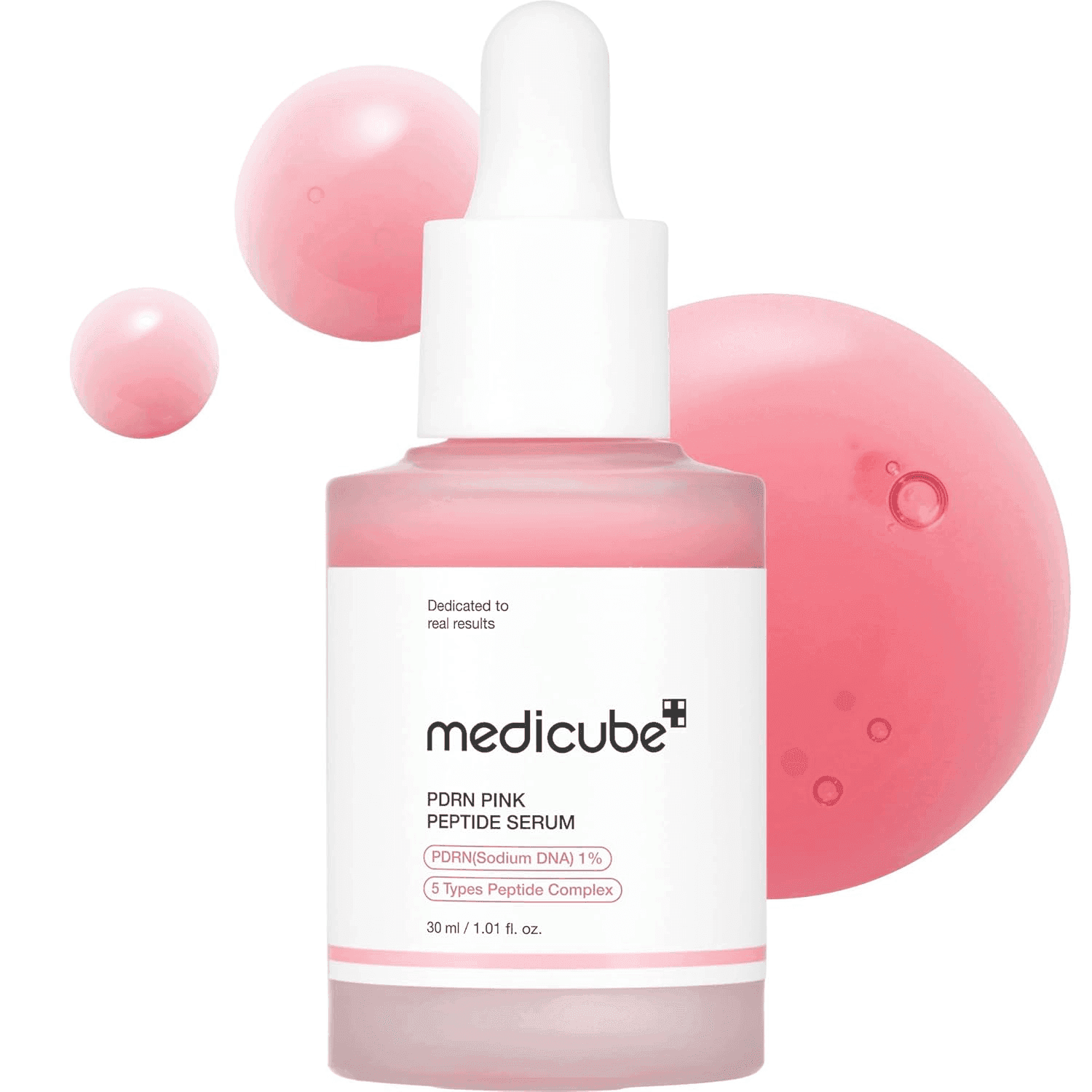
The most-reviewed PDRN product on Amazon by a wide margin: salmon DNA on a five-peptide, niacinamide and adenosine base that does more than the PDRN alone.
Pros
- Salmon DNA — the same source class the human PDRN research is built on
- Genuinely multi-active: five peptides, niacinamide and adenosine share the work
- Inexpensive for the ingredient list, and hugely reviewed so quality control is consistent
Cons
- Sodium DNA is 8th of 40, fairly high, but niacinamide and the peptides drive as much of the visible result as the PDRN
- Contains fragrance, which reactive or fragrance-sensitive skin may not tolerate
- As one serum it cannot cover a whole routine — you will still want a cream or eye product alongside it
| PDRN source | Salmon DNA |
|---|---|
| Format | Serum |
| Skin type | All / normal |
| Size | 1.01 fl oz (30 ml) |
| Key actives | PDRN, 5 peptides, niacinamide, adenosine |
| Fragrance | Yes |
Why we picked it: It is the safest single product to hand someone starting with PDRN — the researched salmon source, a genuinely good supporting formula, a low price tier and nearly twenty thousand ratings — so it wins the overall slot on the balance of evidence, formula and value.
What it's like to use: Reviewers describe a lightweight, fast-absorbing serum that layers cleanly under moisturiser and gives a short-term plumping glow; it is maintenance, not a dramatic corrector.
Best for: Anyone buying their first PDRN product who wants a proven, well-rounded serum without overthinking the choice.
Who should skip it: You react to fragrance, or you want a bare PDRN-and-hydration formula with nothing else in it.
The catch: Like every topical PDRN, the molecule is large and penetration is limited, so it will not reproduce an in-clinic injection.
On the label: DNA listed 8 of 40. Full ingredient analysis →
Anua PDRN Hyaluronic Acid 100 Moisturizing Cream
A fragrance-free salmon-DNA moisturiser built on squalane and hyaluronic acid, with Sodium DNA 7th of 48 — the best everyday cream if you want PDRN in the step that locks everything else in.
Pros
- Salmon-derived PDRN listed unusually high (7th of 48 on retailer lists) in a fragrance-free squalane-and-hyaluronic base
- From a reliable, widely-loved K-beauty brand with a large review base
- Layers cleanly over a serum and under sunscreen without pilling
Cons
- Squalane is the second ingredient, so it feels richer than a gel or water cream
- Anua gives no PDRN concentration, so ingredient order is the only guide to the dose
- The PDRN upside over a good basic moisturiser you may already own is modest
| PDRN source | Salmon DNA |
|---|---|
| Format | Cream / moisturiser |
| Skin type | Normal / dry |
| Size | 2.02 fl oz (60 ml) |
| Key actives | PDRN, squalane, niacinamide, hyaluronic acid |
| Fragrance | Fragrance-free |
Why we picked it: Among PDRN creams it strikes the best balance of a comfortable fragrance-free base, DNA listed higher than in most PDRN products, a reliable brand and a large review base, which is what most people actually want from the moisturiser step.
What it's like to use: Buyers report soft, glass-skin hydration that sits well over a serum and under sunscreen; the effect is comfort and glow rather than firming.
Best for: Normal-to-dry skin that wants its moisturiser to carry the PDRN rather than adding another serum.
Who should skip it: You have very dry or wind-chapped skin that needs a richer occlusive, or you want an ultra-light gel texture.
The catch: Order is not a percentage and Anua states no figure, so judge this mainly on the moisture side; it is a cream with PDRN, not a PDRN treatment in cream form.
On the label: DNA listed 7 of 48. Full ingredient analysis →
BIODANCE Rejuvenating Caviar PDRN Real Deep Mask
An overnight hydrogel mask that holds water against the skin for a next-morning plump. The hydrogel does the work: Sodium DNA is the last of its 47 ingredients.
Pros
- Overnight hydrogel format that clings and delivers a hydration hit
- Caviar water, glycerin and niacinamide make a genuinely hydrating base
- Low commitment — a treat step rather than a daily product to keep up
Cons
- A wash-off / overnight hydrogel gives PDRN only brief surface contact, so it is a hydration-and-glow treat rather than a repair step
- Sodium DNA is the last of 47 ingredients, so the PDRN is a name on the box rather than a meaningful dose
- Single-use sheets add packaging and cost per application compared with a bottle you dispense from
| PDRN source | Salmon DNA (last ingredient) |
|---|---|
| Format | Overnight hydrogel mask |
| Skin type | All, esp. dehydrated |
| Size | Overnight hydrogel sheets |
| Key actives | Caviar water, niacinamide, humectants |
| Fragrance | None listed |
Why we picked it: For the mask slot it is the benchmark overnight hydrogel, an easy weekly hydration boost rather than a daily commitment. We include it for the format, not the PDRN.
What it's like to use: Hydrogels give short-term surface hydration and plumpness that fades without repeat use. That comes from the occlusive gel, not the trace-level PDRN.
Best for: Anyone wanting an occasional, low-effort hydration-and-glow treatment before an event or after a drying week.
Who should skip it: You want a daily leave-on PDRN step, or you dislike the cost and packaging of single-use sheets.
The catch: Brief overnight contact limits how much PDRN can do, so treat it as a hydration mask with PDRN rather than a repair treatment.
On the label: DNA listed 47 of 47. Full ingredient analysis →
medicube Eye Serum with Salmon DNA PDRN & Pink Peptides
A salmon-DNA eye serum with peptides and a low dose of retinol — the best pick for early fine lines and puffiness around the eye.
Pros
- Salmon DNA formulated specifically for the thin, delicate under-eye area
- Peptides plus a cautious retinol level target fine lines and crepiness
- The most-reviewed dedicated PDRN eye product, so the experience is well documented
Cons
- It pairs PDRN with retinol, which can sting or flake on thin under-eye skin if overused
- PDRN is one of several actives, so you cannot credit any firming to the PDRN specifically
- The eye area shows the least independent topical-PDRN evidence, so manage expectations for dark circles
| PDRN source | Salmon DNA |
|---|---|
| Format | Eye cream (sold as eye serum) |
| Skin type | All (eye area) |
| Size | 1.01 fl oz (30 ml) |
| Key actives | PDRN (3,000 ppm), peptides, retinol |
| Fragrance | Fragrance-free |
Why we picked it: It is the most-reviewed dedicated PDRN eye product, fragrance-free and formulated for the thin under-eye area with peptides and a cautious retinol level, and its label discloses Sodium DNA at 3,000 ppm (0.3%), which is what the eye-care slot needs.
What it's like to use: Users report smoother fine lines and a fresher, less puffy look over weeks; results are gradual and depend on consistent use.
Best for: People targeting early fine lines, crepiness or puffiness who want PDRN in an eye-specific format.
Who should skip it: You have very reactive eyes, or you already use a separate retinol and risk stacking irritation.
The catch: The under-eye area has the least independent topical-PDRN evidence, so expect gradual softening, not the results of an in-clinic eye treatment.
On the label: DNA listed 22 of 52 (label states 3,000ppm). Full ingredient analysis →
VT Cosmetics PDRN 100 Essence
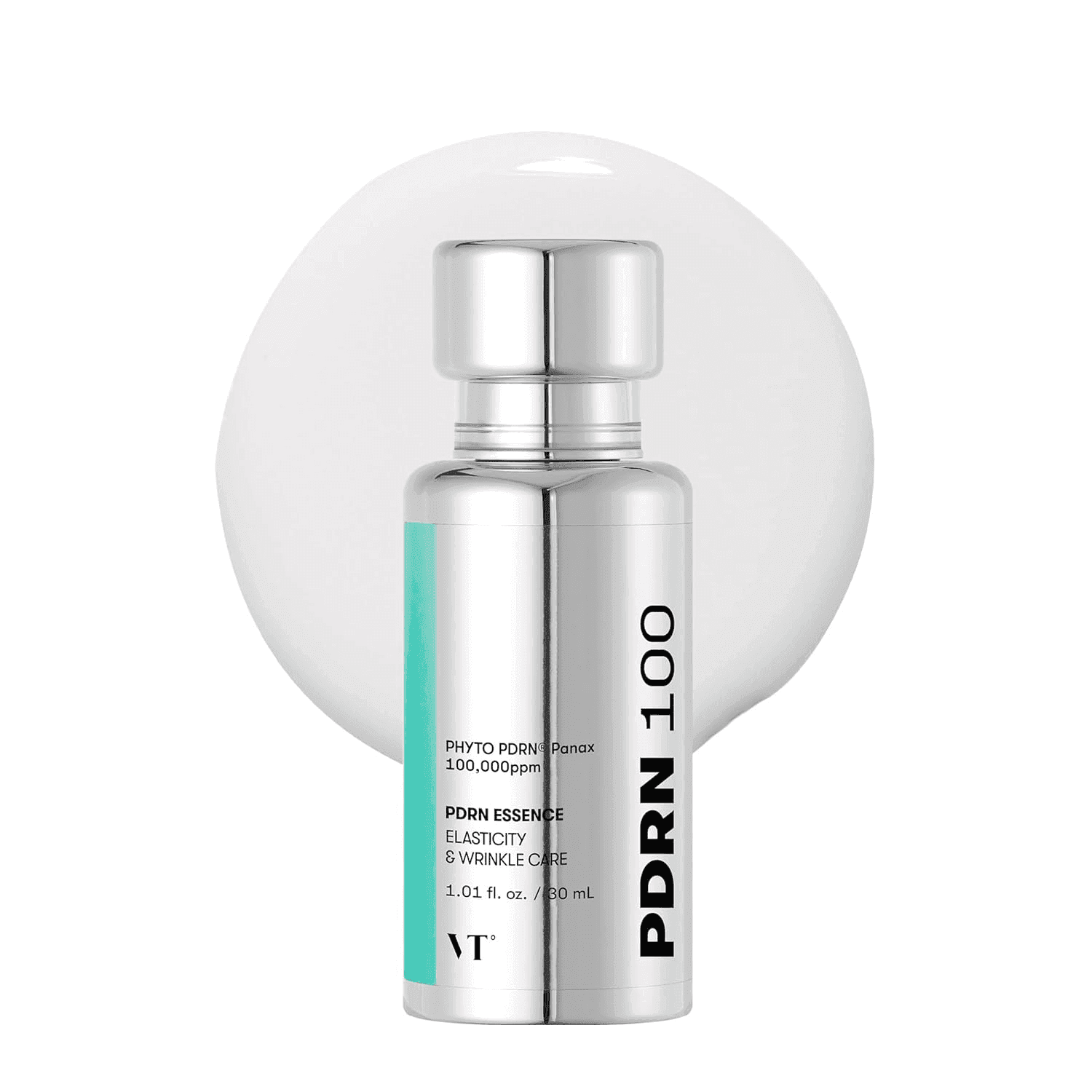
The best-known vegan "PDRN" — a light, fragrance-free essence whose "PHYTO PDRN" is ginseng root extract, not DNA — for vegan or fish-avoidant routines.
Pros
- Marketed as vegan, fish-free PDRN for those avoiding marine-derived ingredients
- Fragrance-free, with niacinamide, ceramides and panthenol in the base
- Light, milky essence texture that layers easily in any routine
Cons
- The "PHYTO PDRN" is ginseng root extract, which is not DNA; the human research studied salmon DNA
- Sodium DNA is the last of 31 ingredients; the 100,000 ppm on the box fits the ginseng extract listed third, not the DNA
- An essence carries fewer actives per drop than a concentrated serum or ampoule
| PDRN source | Ginseng extract (not DNA); trace Sodium DNA, source not stated |
|---|---|
| Format | Essence |
| Skin type | All, incl. fish-avoidant |
| Size | 1.01 fl oz (30 ml) |
| Key actives | Ginseng extract, niacinamide, ceramides, panthenol |
| Fragrance | Unscented |
Why we picked it: For readers who specifically want a vegan or fish-free option, this is the category leader and a well-made, fragrance-free pick for the essence slot — with the honest caveat that its 100,000 ppm figure describes ginseng extract, not DNA.
What it's like to use: Reviewers like it as a hydrating glow layer that sinks in fast; the effect is dewiness and comfort rather than correction.
Best for: Vegan routines, or anyone with a fish or shellfish allergy concern who still wants a PDRN-style step.
Who should skip it: You want the specific salmon-DNA material the clinical literature studied.
The catch: The ginseng "PHYTO PDRN" is not DNA and the actual Sodium DNA is trace-level, so you are buying a ginseng essence, not a PDRN treatment.
On the label: DNA listed 31 of 31. Full ingredient analysis →
medicube Salmon DNA PDRN Pink Collagen Jelly Toner Pads
Jelly toner pads that tone, prep and hydrate daily at a low per-use cost; the label discloses the salmon DNA at 1 ppm, so buy them for the swipe, not the PDRN.
Pros
- Water, glycerin, niacinamide and xylitol make a pleasant quick-swipe hydrator at a low per-use cost
- Doubles as a tone-and-prep step, so it replaces a product you may already buy
- Easy to add to a routine with no learning curve, and widely reviewed
Cons
- Pads spread a thin layer over a wide area, so each pass delivers less PDRN than a targeted serum
- The soak includes exfoliating and soothing acids, which can be too much used twice daily on sensitive skin
- Sodium DNA is 44th of 58 at a disclosed 1 ppm (0.0001%), and the collagen is 2 ppm
- Contains chamomile and rosemary oils, which fragrance-sensitive skin may not tolerate
| PDRN source | Salmon DNA |
|---|---|
| Format | Toner pads |
| Skin type | All / oily-combination |
| Size | Jar of 70 jelly pads |
| Key actives | Niacinamide, xylitol, mild exfoliants; PDRN (1 ppm) |
| Fragrance | Yes (chamomile and rosemary oils) |
Why we picked it: For the budget slot, a jar of daily pads is the cheapest per-use hydrating prep step here. It wins on price and convenience, not PDRN: medicube's own label puts the DNA at 1 ppm.
What it's like to use: Buyers report smoother, prepped, hydrated skin and easier product layering; the pads are a daily-care step rather than a dramatic treatment.
Best for: Cost-conscious buyers who want an easy daily hydrating prep step and do not need a meaningful PDRN dose.
Who should skip it: You avoid essential oils, have sensitive skin that reacts to daily exfoliating-and-soothing acids, or want an actual PDRN treatment.
The catch: At a disclosed 1 ppm the PDRN is a trace, so this is daily glow-and-prep care, not a PDRN step.
On the label: DNA listed 44 of 58 (label states 1ppm). Full ingredient analysis →
How we researched this
- We pulled the most-reviewed PDRN products on Amazon across every format — serums, creams, masks, eye care, essences, ampoules and pads — then kept only those that genuinely feature PDRN (sodium DNA) rather than mentioning it in passing.
- Rather than rank one format above another, we picked a single best product for each format and use case, so a reader who does not yet know which format they want can start here and branch out to a dedicated category guide.
- Where a label discloses the PDRN dose we used it; because most brands do not, we otherwise used ingredient-list order as the honest proxy for prominence and flagged every product where the PDRN sits low.
- We separated salmon-derived PDRN (the source the human literature studied) from plant-derived versions and did not treat them as equivalent.
- medicube appears more than once because it dominates the affordable topical-PDRN category by review volume; we still send format shoppers to our dedicated category guides for the full field. We did not physically test any product and do not claim to have.
How to choose a PDRN product
Start with the format, then read the formula
The best PDRN product for you starts with the job you need done. A serum layers actives under moisturiser; a cream seals hydration; a mask is an occasional hydration-and-glow treat; an eye product is formulated gentle for thin skin; an essence suits oily or vegan routines; an ampoule is a concentrated premium step; and daily pads tone and prep. Each pick above wins one of those jobs. For a deeper category comparison, see our dedicated serum guide (/best/best-pdrn-serum/), cream guide (/best/best-pdrn-cream/) and mask guide (/best/best-pdrn-mask/).
Source: salmon DNA vs plant-derived
The clinical research on PDRN used salmon and trout DNA. Plant-derived "PDRN" (ginseng, rice, red bean) is a newer marketing category with very little independent human data — reasonable if you avoid marine-derived ingredients, but not proven equivalent. If you specifically want the researched material, choose a salmon-DNA product; for that shortlist see our salmon-PDRN serum guide (/best/best-salmon-pdrn-serum/). If your skin reacts easily, our sensitive-skin guide (/best/best-pdrn-for-sensitive-skin/) covers the gentlest options.
Ingredient position beats the ppm on the front
Figures like "100,000 ppm" are unregulated marketing numbers (VT's refers to ginseng extract, not DNA), and regulators do not require brands to disclose a real percentage. The most honest signal is where sodium DNA sits in the ingredient list: high up means it is a genuine feature; near the bottom means it is present at a fraction of a percent and the rest of the formula is doing the work. Judge every product on its ingredient order, not its front-of-pack number.
Set realistic expectations for any topical PDRN
PDRN is a large molecule and topical penetration is limited, so expect hydration, comfort and a short-term glow rather than the firming or scar remodelling associated with in-clinic injections. Match the format to your routine: everyday moisturiser options are compared in our moisturizer guide (/best/best-pdrn-moisturizer/), and under-eye picks in our eye-care guide (/best/best-pdrn-eye-cream/). A topical is maintenance, not a substitute for a clinic treatment.
Frequently asked questions
Which PDRN product should I buy first?
If you are not sure, start with a serum: it is the format that layers PDRN and its supporting actives most directly under the rest of your routine, and our best-overall pick is inexpensive and hugely reviewed. From there, add a cream if you want the moisturiser step to carry PDRN too, or an eye product for the under-eye area. If you already know you want a specific format, jump to that category guide and buy its winner instead.
Do topical PDRN products actually work, or is it just marketing?
Topical PDRN products reliably hydrate and give a short-term plumping glow, and the supporting actives — peptides, niacinamide, hyaluronic acid — do real work. What they cannot reliably do is reproduce the firming and repair seen with PDRN injections, because the molecule is large and skin penetration from a leave-on or wash-off product is limited. Buy one as a good hydrating step with upside, not as a needle-free clinic treatment.
Salmon PDRN vs vegan/plant PDRN — which is better?
Salmon-derived PDRN is the material the human research studied, so it has the stronger evidence base. Plant-derived versions (ginseng, red bean, rice) are gentler on the conscience for vegans and fish-allergic users but have little independent efficacy data. If evidence matters most, choose salmon; if avoiding animal-derived ingredients matters most, choose plant and accept the weaker data. This is general information, not medical advice.
Is a premium PDRN product worth it over a budget one?
Usually not on evidence alone. Price mostly tracks brand and format rather than PDRN quality: our best-overall and best-budget picks are among the cheapest here, while a premium ampoule buys brand pedigree, a concentrated format and packaging — not proven topical superiority. Start affordable unless you specifically want a particular brand or are maintaining a clinic treatment between visits.
Can I use several PDRN products together?
Yes, and layering by format is fine — for example toning pads, then a serum, then a cream, with a mask once or twice a week. Just introduce actives like retinol (in some eye products) gradually to avoid irritation, patch test anything new, and remember that stacking several PDRN products does not multiply a limited topical effect. Give any routine four to eight weeks before judging results.
Sources
- Squadrito F, et al. Pharmacological Aspects and Therapeutic Applications of Polydeoxyribonucleotides. Front Pharmacol, 2017. Link
- Galeano M, et al. Polydeoxyribonucleotide: A Promising Biological Platform. Pharmaceuticals, 2021. Link
- Park H, et al. Polynucleotide and Polydeoxyribonucleotide in Skin: penetration and formulation review. Pharmaceutics, 2025. Link
- U.S. FDA. Cosmetics Labeling Guide (ingredient declaration and concentration disclosure). Link
Why you can trust this guide
- Who wrote it
- PDRN Guide Editorial Team — Research & Editorial. We research PDRN products against the published literature and disclosed formulations. Read our editorial policy.
- How we researched it
- We compared products on disclosed ingredients, verified specifications, format, and aggregated customer-review data from Amazon. We did not physically test these products and do not claim to have.
- Updated
- Affiliate disclosure
- Some links are Amazon affiliate links; we may earn a commission at no extra cost to you. Products are chosen on formulation and evidence, never on commission rate.
- Not medical advice
- This is informational only. For your own skin or any injectable treatment, see a qualified healthcare provider.